AI guardrails fail when labels are trapped in the UI
The real problem most teams miss
A lot of organisations talk confidently about responsible AI, data governance, and secure analytics. Then you look at the actual implementation and realise the controls are still built for humans, not machines.
That is the uncomfortable truth behind many early AI projects.
The data may be labelled. The policies may exist in Microsoft Purview. The compliance team may even have done the hard work of defining what counts as Confidential, Highly Confidential, or Restricted. But if those signals are only easy to see in a portal, or only obvious to a user clicking around in the interface, they are not yet operating as effective guardrails for automation.
And that matters now because more organisations are moving from passive analytics to active workflows. They are wiring up Fabric, Power BI, Purview, Copilot, agents, and custom automation to discover, summarise, route, classify, and act on data at scale. In that world, a sensitivity label is not just a compliance artefact. It is a machine-readable decision point.
That is why Microsoft’s general availability update for Sensitivity labels in Fabric for public APIs is more important than it first appears.
What actually changed
Microsoft Fabric now exposes sensitivity label metadata through core public API operations, including:
- List Items – returns the Sensitivity Label ID for each Fabric item
- Get Item – returns the item’s Sensitivity Label ID
- Update Item – includes the Sensitivity Label ID in the response, though updating labels directly via this API is not supported
That now sits alongside the existing admin APIs for:
- Bulk Set Labels
- Bulk Remove Labels
On paper, that can sound like a modest API enhancement. In practice, it changes how platform teams can build governance into the flow of work.
Previously, if you wanted an automated process to inspect a Fabric estate and make decisions based on classification, you often needed additional metadata lookups per item. That creates friction, latency, and unnecessary complexity. Now the label signal can be returned directly when an item is discovered.
That makes a difference for scale, but more importantly it makes a difference for design.
When the classification signal is available at the point of discovery, it becomes realistic to treat it as a live control in automation, not just a record in reporting.
Why this matters more than the announcement suggests
My take is simple: this is less about labels and more about whether governance can keep up with AI adoption.
Most organisations do not have an AI problem yet. They have a control-plane problem.
They are starting to connect large language models, copilots, data agents, semantic layers, notebooks, and retrieval workflows to enterprise content. But many of the controls still assume a person will stop, inspect, and decide whether something should be used.
That assumption does not survive automation.
If an agent is searching a Fabric workspace to answer a question, recommend an action, assemble a dashboard, or feed downstream reasoning, it needs an immediate way to decide what it is allowed to touch. If the sensitivity signal arrives too late, or only after extra calls and custom plumbing, teams either slow the workflow down or they quietly cut corners.
That is where this API change matters.
It moves sensitivity labels from being mainly visible to users into being directly usable by software. And once software can read a classification signal reliably, you can start building meaningful policy behaviour around it.
For example:
- exclude restricted content from agent retrieval
- trigger approval workflows for highly confidential assets
- route sensitive results to a secure handling path
- flag mislabelled or unlabelled content for remediation
- generate workspace-level classification reports without expensive per-item enrichment
That is the difference between “we have labels” and “our automation respects labels”.
The practical AI angle
This is the part I think matters most for Leon’s audience: AI adoption gets easier when governance signals are available at the same speed as discovery signals.
One of the reasons AI pilots stall is that data teams and governance teams are often working on different clocks.
The AI side wants to ship a proof of value quickly. They want the agent to search across Fabric items, connect to knowledge sources, summarise findings, and return something useful. The governance side quite reasonably asks:
- How do we stop it pulling restricted content?
- How do we know which items were considered?
- How do we prove policy was enforced consistently?
- How do we identify assets that should have been labelled but were not?
If the only answer is “we’ll build a lot of custom checks around that later”, adoption slows down fast.
But if label metadata is already exposed through the discovery APIs, governance becomes easier to integrate into the first version of the workflow.
That is strategically useful.
It means organisations can build agentic or automated Fabric scenarios with a stronger default posture from day one. Not perfect security. Not fully solved governance. But a much cleaner path to policy-aware design.
In other words, this is the sort of infrastructure maturity that helps AI move from demo to deployment.
Two use cases that are more important than they look
Microsoft highlights two obvious scenarios in the announcement, and both deserve attention.
1. AI and agent workflows
This is the headline use case.
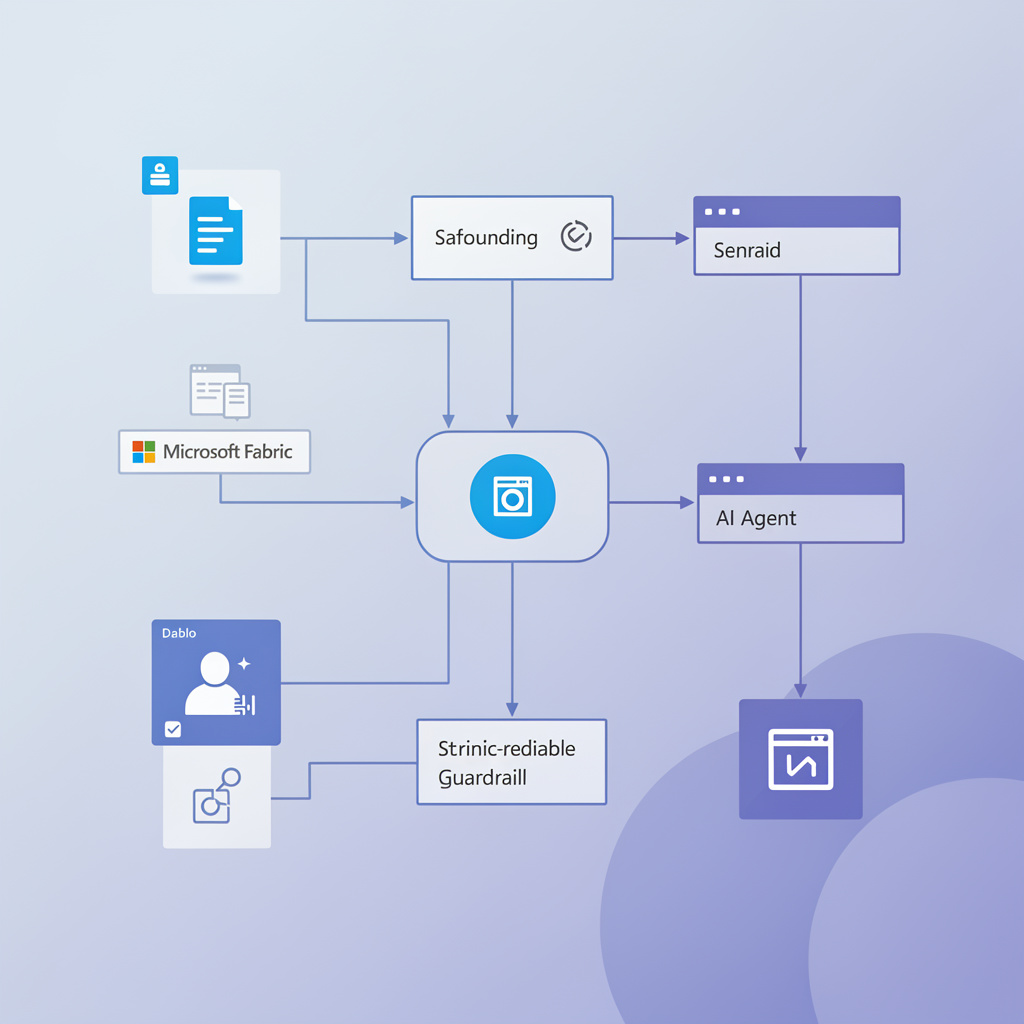
An AI agent or automated workflow searches Fabric items to answer a question or fulfil a task. Because List Items now returns the Sensitivity Label ID directly, the workflow can use that signal immediately as a guardrail.
That guardrail could mean:
- filtering out sensitive artefacts entirely
- requiring human approval before using them
- redacting outputs derived from certain labels
- escalating the request into a secure workflow
The important point is not the specific policy. It is that the workflow can enforce something meaningful without bolting on a second layer of discovery.
That makes the architecture cleaner and the policy easier to operationalise.
2. Workspace classification monitoring
This one is less glamorous, but arguably just as valuable.
Platform teams need a reliable inventory view of what exists in Fabric and how it is classified. The new API behaviour makes it easier to:
- find unlabelled items
- detect assets labelled below the expected classification level
- analyse the distribution of labels across a workspace or estate
- feed dashboards, remediation workflows, or governance reviews
That sounds operational, because it is. But operational clarity is what turns governance from a policy document into a programme.
And for many organisations, getting a live inventory of classification posture is more useful than adding yet another dashboard no one acts on.
The bigger Microsoft story
This update also fits a broader pattern in Microsoft’s platform strategy.
Across Fabric, Purview, Copilot, Foundry, and the wider Microsoft security stack, the direction is increasingly clear: the value is not just in adding AI features. The value is in making governance, identity, classification, and protection signals available across the whole estate in ways that software can use.
That is the real enterprise advantage Microsoft is trying to build.
A model alone is not the moat. A chat interface is not the moat. The moat is whether the surrounding platform can carry context, identity, permissions, labels, lineage, and policy through the workflow.
This sensitivity-label API update is a small but concrete example of that strategy in action.
It gives developers, partners, and internal platform teams a better way to connect information protection signals to day-to-day automation. And that is exactly the sort of plumbing that becomes more valuable as agent usage rises.
What IT leaders should do next
If you are investing in Fabric and looking seriously at AI adoption, I would treat this as a prompt to do three things.
1. Review whether your labels are actually usable by automation
It is not enough to ask whether sensitivity labels exist. Ask whether your workflows, APIs, and integration points can read and act on them early enough to matter.
If the answer is no, your governance model may still be too human-centric for the level of automation you are planning.
2. Build one policy-aware automation path first
Do not try to solve every AI governance problem in one programme.
Pick one scenario, such as:
- a Fabric-based agent that searches workspace content
- an inventory process for classification posture
- a remediation workflow for unlabelled assets
Then use sensitivity labels as a hard decision point in the design. That will teach you far more than a theoretical governance framework ever will.
3. Align Fabric and Purview teams early
This change only becomes useful if classification standards are meaningful and consistently applied. If Fabric automation is advancing faster than your Purview policies, or vice versa, you will still end up with a gap.
The win comes when the platform team, the data team, and the governance team are all designing for the same operational model.
The caveat worth naming
There is an important limit here.
This update does not mean governance is solved. Exposing label metadata through APIs is foundational, not final. Organisations still need:
- sensible label taxonomy
- strong Purview policy design
- operational processes for remediation
- clear rules for when automation should stop, escalate, or continue
- visibility into how AI workflows are actually using enterprise content
It also matters that labels cannot be updated through the standard item update API in this flow. That is the right constraint from a control perspective, but teams need to understand the separation between reading labels in core operations and managing labels via the dedicated admin paths.
So the right reading of this announcement is not “Fabric governance is complete”. It is “Fabric just got more usable as a governed automation platform”.
That is a valuable step.
Final thought
The organisations that get AI adoption right will not be the ones with the flashiest demos.
They will be the ones that make policy signals available at the point where machines make decisions.
That is why I think this Fabric update matters.
Most teams still treat sensitivity labels as documentation for people. Microsoft is steadily turning them into control signals for software. And if you want agents, copilots, and automated workflows to scale safely across your data estate, that is exactly the direction you need.
The headline is not that labels are now visible in an API.
The headline is that governance is becoming programmable.
Leon Godwin, Principal Cloud Evangelist at Cloud Direct