Fabric’s Lakehouse auto-binding in Git fixes a problem most data teams normalised
The Challenge
Most teams think Git adoption in analytics fails because people resist engineering discipline. That is not usually the real issue.
The real issue is environment friction. A notebook works in development, then breaks in test because the lakehouse reference points at the wrong workspace asset. It works again after someone manually patches the binding, then breaks in production during deployment. Over time, the team starts treating those fixes as normal operational work.
That is exactly the kind of friction that slows down AI and data programmes. Not because the idea is wrong, but because the plumbing is too fragile to scale with confidence.
Microsoft’s new Lakehouse auto-binding support for Fabric notebooks in Git is a preview feature aimed squarely at that problem. And while it sounds minor on first read, I think it matters more than many of the flashier announcements.
In practice, this is about making notebooks behave more like production assets and less like environment-specific artefacts. For organisations trying to move from isolated experiments to repeatable data engineering and AI delivery, that is a meaningful shift.
What’s Changed
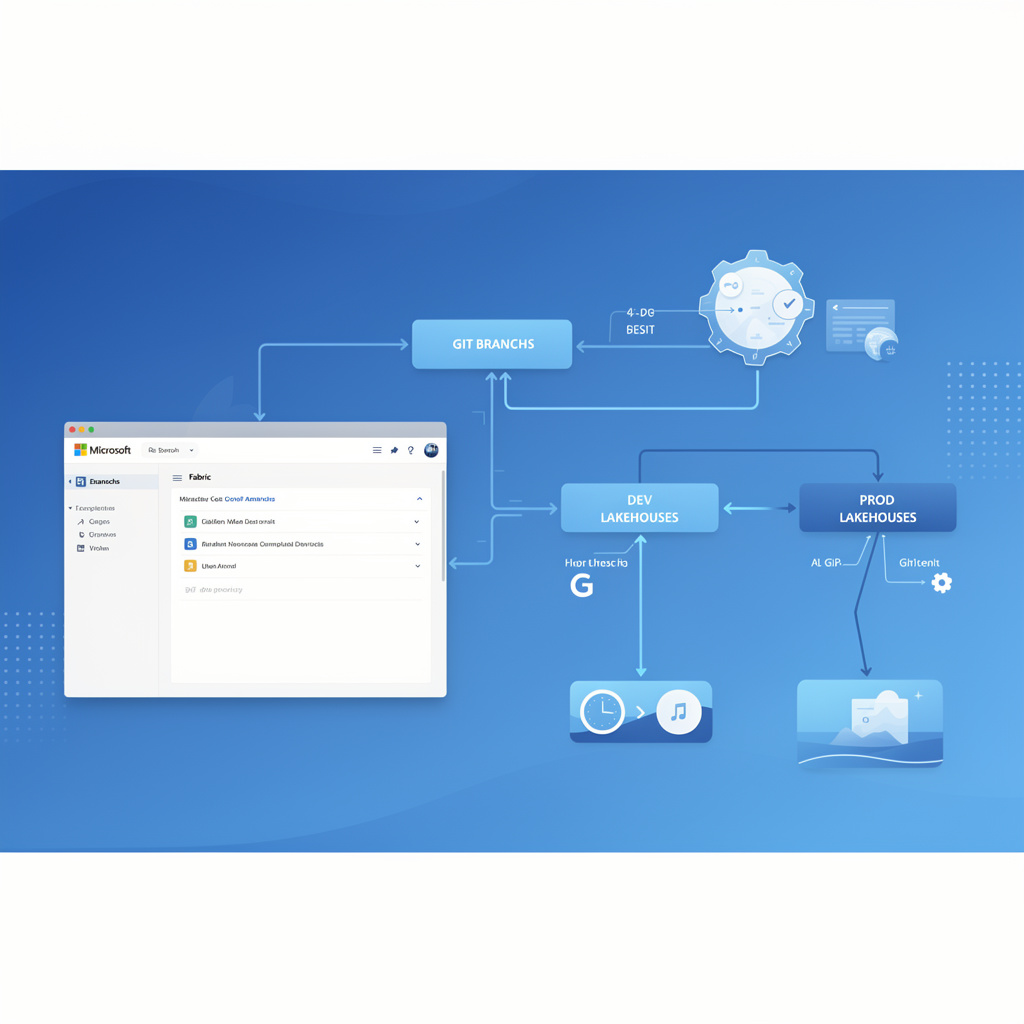
Fabric notebooks now support lakehouse auto-binding when used with Git. Instead of hard-binding a notebook to one specific lakehouse reference and then forcing teams to rework that dependency across development, test and production workspaces, Fabric can resolve the correct default lakehouse for the Git-connected workspace automatically.
That matters because the old model created hidden deployment debt. The notebook itself might be under version control, but part of its usefulness still depended on manual environment alignment. If the data platform team had to keep rebinding lakehouses after every promotion, the process was not really automated.
According to Microsoft’s documentation, the feature works alongside Fabric’s Git integration and deployment pipeline behaviour for lakehouse references. Notebooks and Spark job definitions can be remapped to the appropriate lakehouse as workloads move between environments. The result is less manual correction and fewer environment-specific edits hiding inside notebook settings.
For me, the bigger point is not convenience. It is operational reliability.
If your Fabric estate is supporting analytics, machine learning preparation, or agentic workloads that depend on governed data access, every unnecessary manual step becomes a control weakness. Someone has to remember what to bind, where to bind it, and when to check it. That is where avoidable errors creep in.
This preview reduces some of that overhead. It helps teams keep one notebook artefact in source control while letting the platform resolve the right lakehouse context in each workspace. That is the kind of feature that supports cleaner promotion paths and a more defensible operating model.
There is also a broader architectural signal here. Microsoft is steadily making Fabric friendlier to proper software delivery practices, not just analyst productivity. Git-backed notebooks, resource-folder support, pipeline mapping, and now auto-binding all point in the same direction: fewer hand-tuned assets, more repeatable delivery.
That is important for enterprise buyers. AI adoption is rarely blocked by model access alone. It is blocked by whether teams can move data and logic safely between environments without turning every release into a small incident.
Getting Started
If you are already using Fabric notebooks with Git, this is worth testing in a controlled dev-to-test path first.
Start by reviewing how your notebooks currently reference lakehouses and where manual rebinding happens today. If your team has a release checklist that includes steps like “open notebook settings” or “fix default lakehouse after deployment”, you have found the exact friction this preview is trying to remove.
Then review the official Microsoft documentation on notebook source control and lakehouse Git integration in deployment pipelines. Pay close attention to how Fabric handles remapping, what gets created automatically, and where custom mapping still applies. This is not the sort of feature to switch on blindly in a complex estate.
A sensible first exercise is to take one notebook-driven workload with clear development, test and production workspaces and walk it through a full Git-based promotion cycle. Measure three things:
- how many manual interventions are still required
- whether notebook execution behaves consistently after promotion
- whether your support documentation can be simplified
That sounds basic, but it is the right test. The value of this feature is not that it looks elegant in a demo. The value is whether it removes brittle steps from the real delivery path.
I would also encourage teams to treat this as a governance conversation, not just a feature test. Ask:
- Which lakehouse mappings are implicit versus explicitly governed?
- Who owns workspace promotion standards?
- Are notebook dependencies visible enough for platform teams to support confidently?
- Does this reduce release risk, or simply hide complexity somewhere else?
Those questions matter because the preview improves workflow mechanics, but it does not replace platform discipline. You still need naming standards, environment strategy, access controls and a clear promotion model.
A practical customer example: imagine a team building notebook-based data preparation for an internal Copilot or AI search experience. The model layer gets the attention, but the real delivery risk often sits lower down. If the underlying notebook points at the wrong lakehouse after promotion, you do not just have a technical defect. You have a trust problem. Outputs become inconsistent, testing becomes noisy, and confidence in the whole AI initiative takes a hit.
That is why I see this as more than a notebook feature. It is foundational engineering for trustworthy AI delivery.
What This Means
The non-obvious lesson here is that AI readiness often looks boring.
It looks like removing manual rebinding. It looks like predictable promotion between environments. It looks like fewer undocumented fixes sitting in someone’s head. Those are not glamorous capabilities, but they are exactly what separates a promising demo from a platform the business can rely on.
In my experience, organisations get more value from reducing operational ambiguity than from adding another layer of novelty. Fabric’s Lakehouse auto-binding in Git is a preview, so it needs proper validation. But the direction is the right one.
If Microsoft can keep turning notebook-heavy workflows into cleaner, more portable, and more governable assets, that helps customers build data foundations that AI can actually stand on.
And that is the bit many teams still underestimate.
Leon Godwin, Principal Cloud Evangelist at Cloud Direct